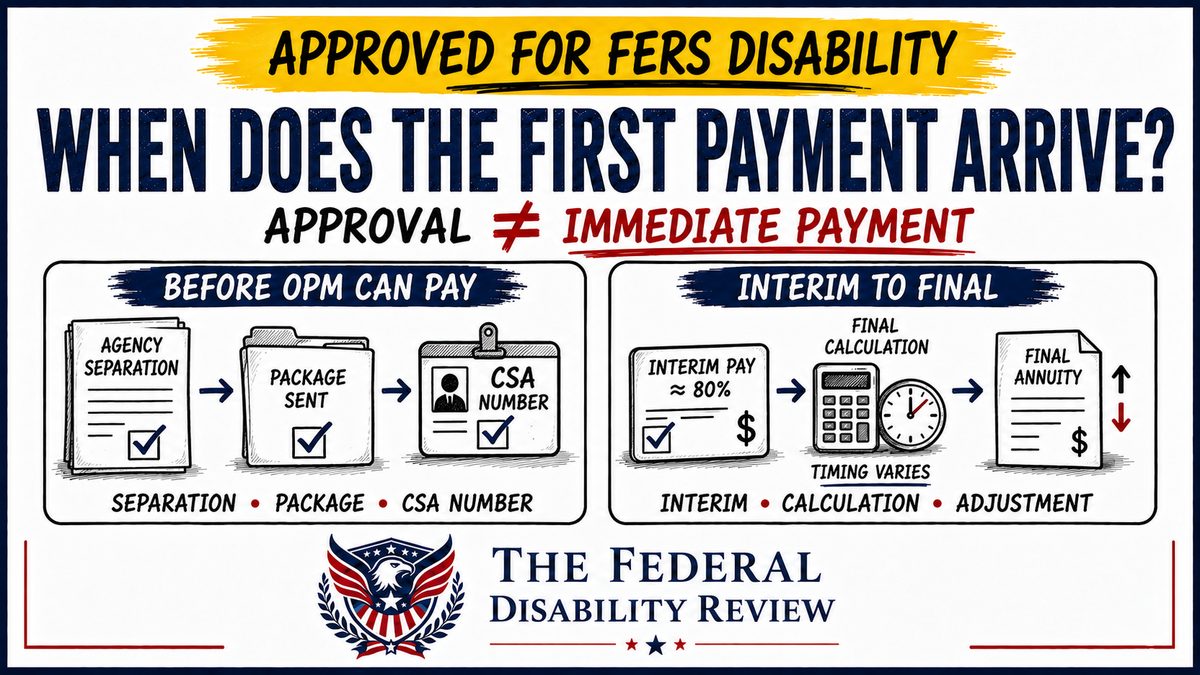
One of the most common questions I get after an approval is when the first payment will actually arrive. It is a reasonable thing to want to know, and the honest answer has a few moving parts. Here is how it usually works, and what to plan around while you wait.
General educational information only. TFDR is not a law firm or a financial advisory firm, does not provide legal, financial, or tax advice, and does not represent applicants before OPM or predict individual outcomes.
The approval letter doesn't start the payments
This is the part that surprises people. The approval is OPM saying yes to the disability retirement. It is not OPM saying the money is on its way.
If you are still employed when the approval comes, your agency has to process your separation and send your retirement package to OPM. Nothing can be paid until OPM has that package in hand.[1] So the first stretch of waiting depends on how quickly your agency finishes its side, and that varies a lot from one agency to another.
If you were already separated when you applied, that step is behind you. Your application went to OPM directly, so OPM already has what it needs to set up your file once the decision is made.
One thing that helps to know: your annuity is generally computed from the day after your federal pay stops, not from the day the first deposit lands. The waiting period is not lost money. It gets paid later, retroactively, once OPM catches up.[5]
Where the CSA number comes in
Once OPM has your file, it assigns you a claim number, called a CSA number, and sets you up in its retirement system.[1] That number is your identity with OPM from here on. It goes on every letter, every call, and every login to OPM Retirement Services Online, which is where you can check the status of your case and update your contact and payment information.
Keep it somewhere you can find it. When you contact OPM about anything, the first thing they ask for is the claim number, and a call goes much faster when you have it ready.
Interim pay: what it is and how long it lasts
After the CSA number is assigned, OPM starts what it calls interim pay. This is a temporary monthly payment that gives you income while OPM finishes calculating your actual annuity.[3]
OPM describes interim payments as typically 60 to 80 percent of your estimated annuity.[1] In the cases I have worked with, the amount has usually landed near the top of that range, around 80 percent of what OPM expects the final annuity to be. Interim pay is deliberately set on the low side so OPM does not have to take money back later, which is why it can be a bit less than 80 percent when a file has questions OPM still has to resolve.
Interim pay usually lasts somewhere around five to six months, though it can run shorter or longer. It continues until OPM finishes the final calculation, and there is no set timeline for that part. OPM's own guide describes the calculation stage as anywhere from a couple of weeks to several months.[1]
A few details about interim pay that catch people off guard:
- Only federal income tax is withheld. State tax and your health and life insurance premiums are not taken out during interim pay, even though your FEHB and FEGLI coverage stays active.[2]
- Those premiums come due at the end. When OPM finalizes your case, the insurance premiums that were not withheld during interim pay are deducted from the adjustment payment.[1] That is one reason the back-pay deposit is often smaller than people expect.
- Payments arrive on the first business day of the month and cover the previous month, so the deposit that arrives June 1 is for May.[1]
The final calculation, and the adjustment that follows
When the final calculation is done, your regular monthly annuity begins. OPM then reconciles what it paid during interim against what you were actually owed.
If the interim payments were lower than your final annuity, OPM pays you the difference in an adjustment payment.[1] That is the outcome most people are hoping for, and it is the common one.
In some cases, though, the final numbers come out lower than the interim payments, and OPM recovers the overpayment. This happens more often when Social Security disability is involved, because SSDI reduces the FERS disability annuity[4] and the two agencies do not always finalize at the same time. If OPM set up your interim pay before it knew your SSDI amount, the final annuity can drop once that offset is applied, and the months already paid at the higher rate become an overpayment.
Because of that, many people choose to treat the interim period carefully and set aside the SSDI payments in particular until the final annuity is in place. Once the actual numbers are known, it becomes clear what is yours to keep. What is right for your situation depends on your own finances, and that is a conversation to have with a licensed financial or tax professional.
Plan around the first-year number, not your old salary
The other thing that softens the wait is knowing what "final" is likely to look like. For most people, the first year of a FERS disability annuity is 60 percent of the high-3 average salary, reduced by 100 percent of any SSDI received. After the first year, it drops to 40 percent of the high-3, reduced by 60 percent of SSDI. Those percentages are set by law,[4] so the final calculation is not a mystery, even if the timing is.
If you want to see what that math looks like with your own numbers, the free annuity estimator on this site walks through it. It is an educational estimate only. The official figure comes from OPM.
If you're in the waiting period now
Two steps are worth more than anything else during this stretch:
- ☐ Confirm your agency has submitted your package to OPM. Ask your HR or retirement office directly and get a date. Until OPM has the package, the clock has not really started.
- ☐ Keep your CSA number available for any contact with OPM, and use it to check your case status in Retirement Services Online rather than waiting on the mail.
Beyond that, the most useful mindset is to treat interim pay as what it is: a bridge, not the destination. The final numbers will come. Knowing ahead of time that they can move in either direction is what keeps the adjustment from being a bad surprise.
Sources
[1] OPM, Retirement Quick Guide — what happens after separation, interim payments (typically 60–80% of estimated net annuity), the adjustment payment and premium deductions, payment dates — opm.gov
[2] OPM, Retirement FAQ: Interim pay during retirement processing — opm.gov
[3] OPM, Retirement FAQ: Understanding annuity payments — opm.gov
[4] 5 U.S.C. § 8452 — FERS disability annuity computation and the Social Security offset — uscode.house.gov
[5] 5 CFR Part 844 — FERS disability retirement (eligibility, applications, computation, termination) — ecfr.gov
Interim-pay duration and typical amounts described above reflect the author's case experience and vary by case. OPM Retirement Services Online: servicesonline.opm.gov.
Approved and not sure what comes next?
Post-retirement support covers the interim period, the 80% earnings rule, and OPM reporting — so the first year isn't guesswork.
Get a Free Assessment