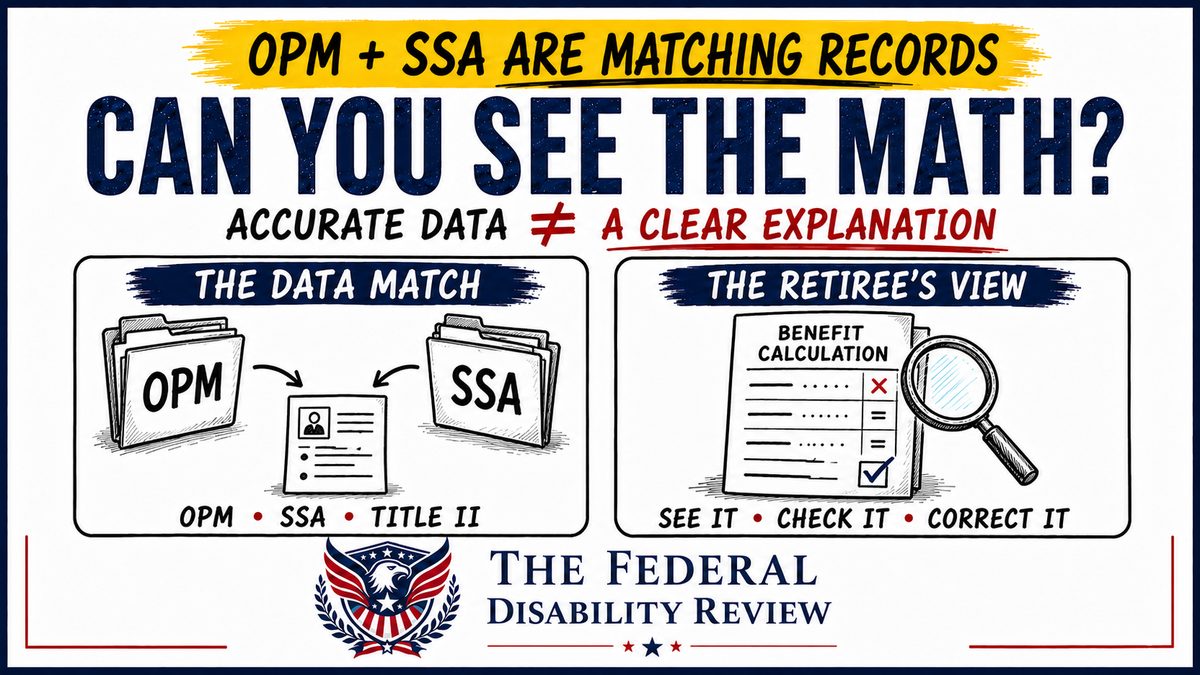
OPM is re-establishing a data-matching program with Social Security. The program itself is not the problem. The real issue is whether FERS disability retirees can see, understand, and correct the information used to calculate their benefits.
The government can compare the records. But can the retiree verify the result?
On August 6, 2026, the Office of Personnel Management published notice that it is re-establishing a computer-matching program with the Social Security Administration. The stated purpose is to allow SSA to provide Title II Social Security benefit information to OPM so that OPM can determine eligibility for, and calculate, certain FERS disability and survivor benefits—including statutory offsets.[1]
That sounds technical because, frankly, government notices are allergic to speaking like human beings. In plain English, OPM wants a formal way to check SSA information against its own retirement files when a FERS disability annuity may be affected by Social Security disability benefits.
Correct benefit calculations matter. No reasonable person is arguing that OPM should ignore information that federal law requires it to use. But there is a second question that matters just as much:
When two agencies compare records that can affect a disabled retiree’s monthly income, will the retiree be able to see what information was used, understand the calculation, and correct an error before the problem becomes a debt, a delay, or a reduced payment?
The Federal Register notice explains the data match. It does not answer every retiree-facing transparency question that follows from it.[1]
What OPM and SSA will actually compare
Under the published notice, OPM will provide SSA with identifying information, including the individual’s full name, Social Security number, date of birth, and an indicator used to retrieve Title II benefit information. SSA will verify the Social Security number and, when there is a match, return the person’s Title II beneficiary status and associated benefit information from SSA’s Master Beneficiary Record. If the Social Security number does not verify, SSA will return a code explaining the non-match.[1]
The notice identifies three groups whose information may be involved: FERS disability annuitants who may receive Social Security disability insurance benefits, FERS child survivor annuitants who may receive Social Security child’s insurance benefits, and certain FERS surviving spouses.[1]
The program is scheduled to begin on October 27, 2026, unless comments require OPM to modify and republish the notice.[1]
| In ordinary language | What the notice says |
|---|---|
| OPM asks SSA, “Is this person receiving or entitled to a relevant Title II benefit, and what is the information we need?” | OPM sends identifying information; SSA verifies the Social Security number and returns beneficiary status and associated Title II benefit information when there is a match.[1] |
| OPM compares SSA’s response to its FERS records. | OPM states it will use the information to determine eligibility for and calculate covered FERS disability and survivor benefits, including statutory offsets.[1] |
| If the records do not line up, somebody has to resolve the discrepancy. | The notice identifies the matching process, but it does not lay out a retiree-facing, step-by-step explanation of how a person will receive the data used or challenge an apparent mismatch.[1] |
Why SSA information can change a FERS disability calculation
This is not a new offset rule. The relationship between certain FERS disability annuities and Social Security disability benefits is already built into federal law.
For many FERS disability retirees who are under age 62 and are receiving the disability computation rather than an immediate-retirement earned annuity, the statute generally provides a benefit equal to 60% of average pay during the first 12 months and 40% afterward. For months in which the person is also entitled to Social Security disability insurance benefits, the FERS annuity is generally reduced by 100% of the relevant Social Security disability benefit during the first 12 months and by 60% after that period. The law also provides an earned-annuity floor in the circumstances described by the statute.[2]
OPM explains the same framework in its public FERS retirement guidance. It also confirms that a person applying for FERS disability retirement must apply for Social Security benefits; if that Social Security application is withdrawn, OPM will dismiss the FERS disability application after SSA notifies OPM.[3]
That connection is why accurate SSA data matters. The FERS and Social Security programs remain separate, but the amount of one can affect the calculation of the other.
A hypothetical example
This is an illustration, not a client story.
Imagine a federal employee who separates because a medical condition prevents useful and efficient service. The employee applies for FERS disability retirement and also applies for Social Security benefits, as the FERS process requires. Months later, SSA determines that the person is entitled to disability insurance benefits.
At that point, OPM needs accurate information about the SSA entitlement and relevant benefit amount to apply the existing FERS formula. That is not controversial. The difficulty comes when the retiree cannot easily tell whether OPM used the correct date, the correct benefit figure, the correct period of entitlement, or the correct identity record.
A mismatch could be as ordinary as a delayed SSA record update, a name variation, an incorrect commencement month, or an incomplete explanation of the number OPM used. To someone living on a disability annuity, that is not a minor administrative annoyance. It can determine whether the next payment is right, whether an overpayment notice appears later, or whether a retiree spends months trying to reconstruct two agencies’ calculations from letters that do not quite speak to each other.
The data match is not the problem. Being kept outside the process is.
There is a sensible argument for the OPM–SSA match. It can reduce reliance on handwritten reporting, incomplete documentation, and manual record comparisons. It may help OPM apply the existing statutory offset more accurately.[1][2]
But a more accurate government-to-government process is not automatically a more transparent retiree-to-government process.
The basic fairness question is simple: if a record match is going to affect a person’s disability income, that person should be able to understand the result without becoming the unpaid investigator assigned to reconcile OPM and SSA records.
A retiree should be able to ask—and receive clear answers to—the following questions:
| Question the retiree should be able to ask | Why it matters |
|---|---|
| What SSA information did OPM use? | A calculation cannot be meaningfully checked if the underlying SSA entitlement date and benefit information are invisible. |
| Which months did OPM treat as months of concurrent entitlement? | The statutory reduction turns on the applicable period of entitlement.[2] |
| Which FERS formula did OPM apply? | The first-12-month and post-12-month computations differ.[2][3] |
| Is there a discrepancy between the OPM and SSA records? | A mismatch should be identified clearly, rather than surfacing later as confusion, delay, or a debt notice. |
| What is the path to correct an error? | A person needs a practical route to provide records and obtain a corrected calculation when the agencies’ data does not reflect reality. |
None of this requires OPM to ignore the law. It requires OPM to explain how the law was applied to the individual record.
What this notice does—and does not—mean
The August notice deserves some restraint. It is a notice of a re-established data-matching program, not a new act of Congress and not a new medical-review rule for FERS disability retirees.[1]
It does not announce a new FERS disability eligibility standard. It does not create a new Social Security offset percentage. It does not mean every FERS disability annuity will be reduced. And it does not mean SSA, rather than OPM, now decides whether a person qualifies for FERS disability retirement. The underlying FERS eligibility and computation rules remain the rules that control.[2][3]
What it does mean is that OPM is formalizing its ability to receive relevant SSA Title II information for the covered FERS disability and survivor calculations.[1]
The real standard should be clarity before correction
The federal government has a legitimate interest in calculating benefits correctly. Disabled federal retirees have an equally legitimate interest in knowing how the calculation was made before they are expected to live with the consequence.
The best version of this program would do more than match records in the background. It would provide a plain-language explanation when the match affects an annuity calculation, identify the SSA information used, state the months involved, show the formula applied, and give the retiree a practical opportunity to correct a mismatch.
That is not asking for special treatment. It is asking for basic administrative fairness.
For federal employees applying for FERS disability retirement—and for current annuitants—the practical lesson is to keep copies of Social Security award notices, changes in benefit status, and OPM annuity correspondence. Just as important, do not treat a number on an agency letter as self-explanatory. When a calculation changes, it is reasonable to ask what information was matched, what period it covers, and how OPM applied the FERS formula.
Because when two federal agencies compare your records, you should not be the last person allowed to understand the result.
This article is for general educational purposes and is not individualized legal, financial, or benefits advice.
Sources
[1] OPM, “Privacy Act of 1974; Re-Established Matching Program,” 91 FR 50897 (Aug. 6, 2026) — federalregister.gov
[2] 5 U.S.C. § 8452 — uscode.house.gov
[3] OPM, FERS Information: Types of Retirement — opm.gov
Receiving a FERS disability annuity?
Keeping your SSA and OPM records organized is exactly what post-retirement support is for.
Get a Free Assessment