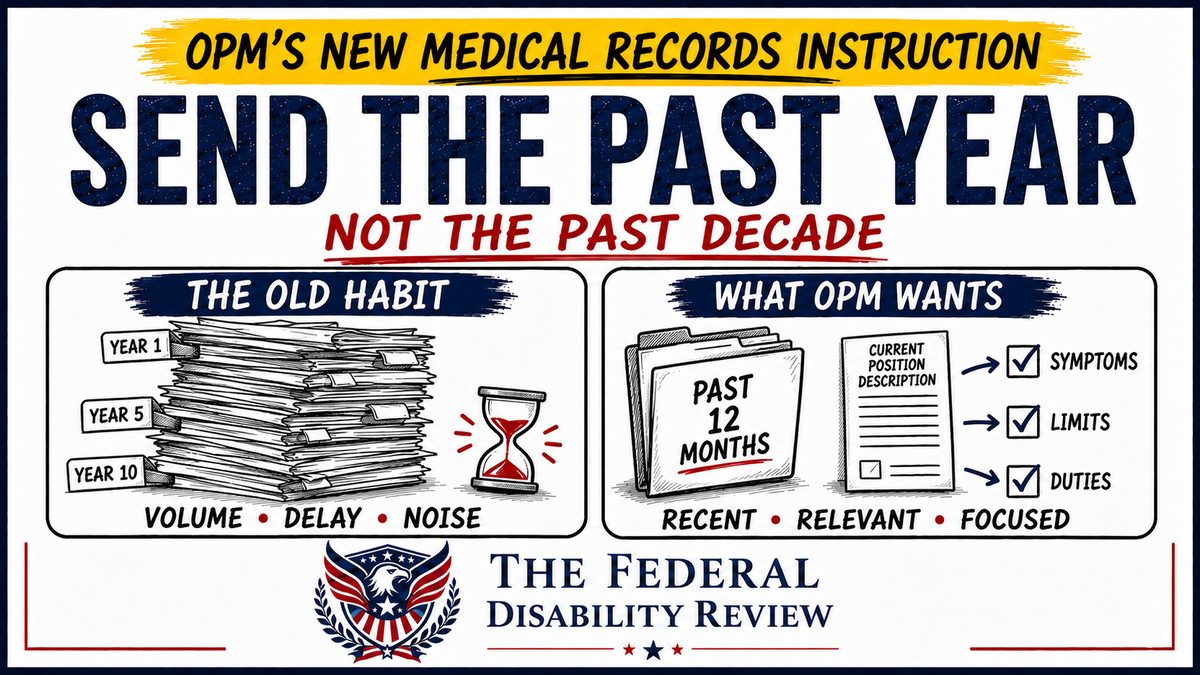
Inside OPM’s new online disability retirement application is a quiet instruction that changes years of filing practice: upload medical documentation from the past year only. Here is what it says, why it matters, and how to build a record under the new approach.
General educational information only. TFDR is not a law firm and does not provide legal or medical advice, represent applicants before OPM, or predict individual outcomes.
When OPM moved the FERS disability retirement application into its Online Retirement Application, most of the attention went to the obvious change: the filing is digital now. But sitting inside the medical documentation section is a short instruction that may matter just as much, because it reverses a habit that shaped disability retirement filings for years.
The instruction, as it appears in the application, tells applicants to upload medical documentation from the past year only — that submitting records older than one year may delay application processing, and that OPM will contact the applicant directly if additional documentation is needed.
Read that again, because it is the opposite of how many applications used to be built.
The old habit: when in doubt, send everything
Under the paper process, applicants commonly submitted two or three years of medical records, and sometimes far more. The reasoning felt safe: the burden of proof belongs to the applicant, nobody wanted to leave out the one page that might matter, and there was no signal from OPM about how much was too much. So packages grew. Hundreds of pages of visit notes, labs, imaging reports, and specialist records went into envelopes on the theory that more paper meant more proof.
The trouble is that volume was never the same thing as evidence. A specialist reviewing a disability retirement case is looking for documentation that speaks to a specific question: how the applicant’s medical conditions affect their ability to perform their position. A three-inch stack of records where most pages say nothing about function does not answer that question faster. It answers it slower.
What the new instruction changes
The past-year instruction turns record-gathering from a collection task into a selection task. The question is no longer “how much history can I document?” It is “do my recent records actually show the limitations I am describing?”
That is a different kind of work, and in some ways a harder one:
- Recency now matters more than volume. The system is built to receive the last twelve months — the records that show what your conditions do to you now, in the position you hold now.
- Relevance is the filter. A record earns its place by documenting symptoms, restrictions, treatment response, or functional limits that connect to your duties — not by existing.
- Gaps become visible. If your last year of records is thin because appointments lapsed, that is worth knowing before you file, while there is still time to see your providers and let the current picture get documented.
What the instruction does not mean
A few careful boundaries, because a short instruction invites overreading.
It does not mean older history is irrelevant to your case. Long-running conditions still get told — through your physician’s statement, which can describe the course of treatment, and through recent records that reference the history. The change is about what you upload, not about what your doctor can say.
It does not mean OPM will never look further. The instruction itself says OPM will contact you directly if additional documentation is needed. Keep your older records organized at home; they simply are not the opening submission anymore.
And it does not lower the evidence standard. Your application still has to show a medical condition that interferes with useful and efficient service in your position. Twelve months of well-chosen records can carry that showing. Twelve months of thin ones cannot, and neither could three hundred unfocused pages under the old habit.
How to build a record under the new approach
- ☐ Pull your medical records for the last twelve months — all providers who treat the conditions in your application.
- ☐ Read them against your position description. Do they document the restrictions that affect your specific duties?
- ☐ If the recent record is thin, see your providers before you file. Let the current severity and limitations get documented in real visit notes.
- ☐ Give your physician your current position description before they write their statement — the statement is where history and function come together.
- ☐ Keep older records organized and reachable, in case OPM asks.
Why this is good news
For applicants, this instruction is a gift dressed as a restriction. It replaces an impossible task — guess how much of your medical life to photocopy — with a clear one: show the last year, clearly, and make it speak to your job. It also means the person reviewing your case reads a focused record instead of hunting through years of pages, and a focused record is one where your strongest evidence is actually seen.
The application moved online. The evidence standard stayed put. And in between, quietly, OPM told everyone what it actually wants to read. That is worth taking at its word.
Sources: OPM, Online Retirement Application (ORA) — medical documentation instruction as displayed in the disability application (August 2026); OPM, Applying for FERS Disability Retirement; the ORA portal is at retire.opm.gov/portal.
Building your record for the new system?
Records curation and careful review are exactly what the coaching service is for.
Get a Free Assessment